The Role of Smart Wearables in Artistic Performance
26 August 2026
Let us begin with a moment of silence for the last time a dancer walked on stage without a silicon band strapped to their wrist, checking their heart rate mid-pirouette. That moment is gone. The era of the smart wearable in art is not coming; it is already here, and it is wearing a slightly too-tight band and buzzing to remind you to stand up.
If you have attended a contemporary dance show, a live music performance, or an interactive art installation in the last five years, you have likely witnessed the strange marriage of biometric sensors and aesthetic expression. The results are sometimes breathtaking. Other times, they look like a fitness tracker got lost on its way to a spin class and wandered onto a stage. As someone who has spent years building and breaking interactive performance systems, I can tell you that the potential is enormous, but the path is littered with dead batteries, dropped Bluetooth connections, and artists who have accidentally triggered a light show by sneezing.
This is not a review of the Apple Watch. This is a field guide to using these devices as instruments, not accessories.
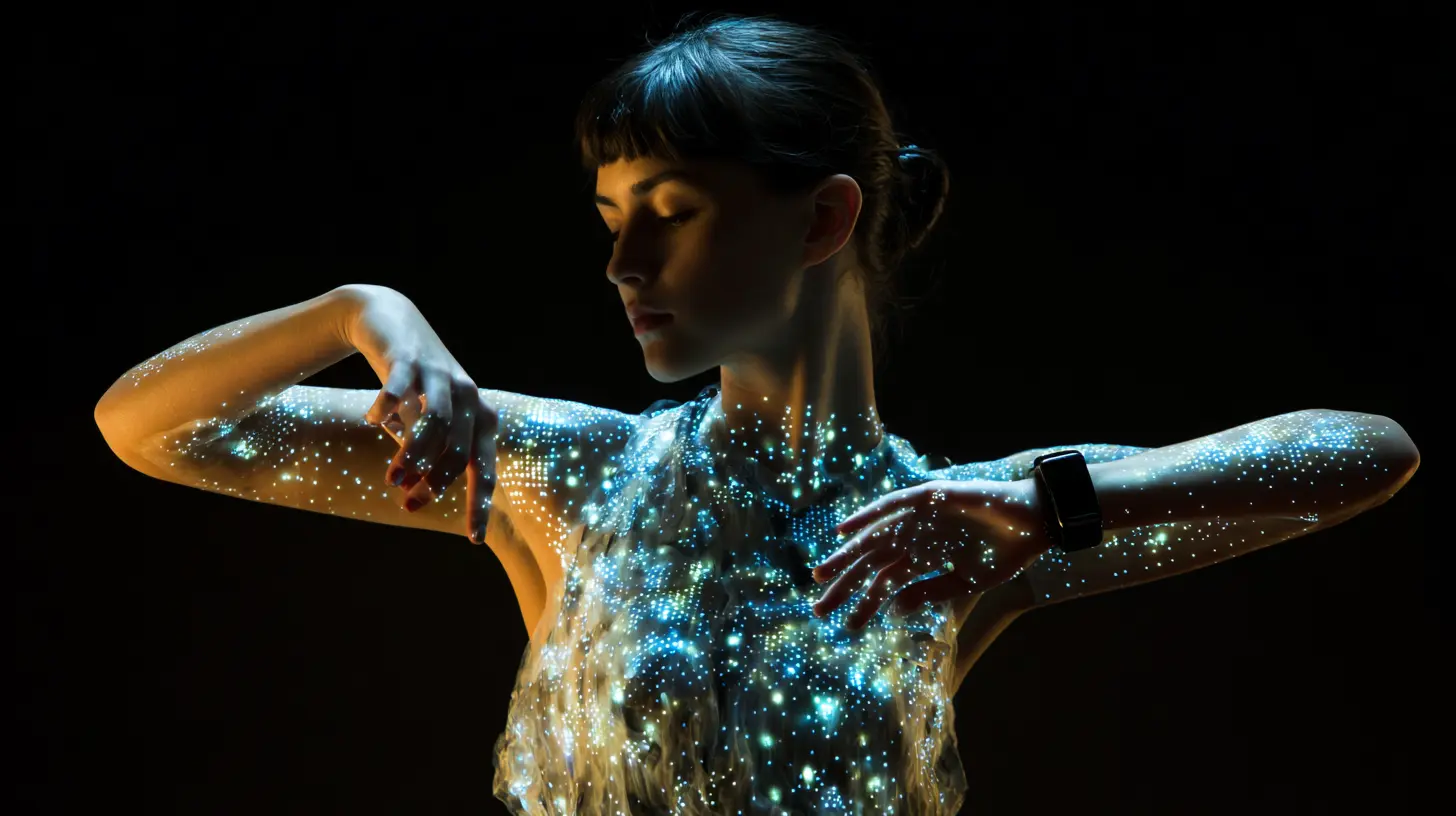
The Fundamental Mismatch: Why Your Heart Rate Is Not a Cello
The first thing every artist must understand is that a smart wearable is not a musical instrument. It is a sensor platform designed for health tracking, sleep monitoring, and notification delivery. Its primary purpose is to measure your body for medical or fitness reasons. An instrument is designed to be played. A wearable is designed to be worn.This distinction matters because it explains why most "wearable art" fails. When a performer straps on a heart rate monitor and projects their pulse onto a screen, the audience sees a number going up and down. That is not art. That is a vitals monitor with better lighting.
The successful performances treat the wearable as a source of raw, unreliable, and sometimes chaotic data. The artist then builds a system that translates that data into something meaningful. The wearable is the input, not the output. The art is in the interpretation.
Consider the work of a choreographer who placed an accelerometer on a dancer's ankle. The sensor did not measure "grace" or "emotion." It measured raw acceleration in three axes. The system then used that data to control the intensity of a projected visual field. When the dancer moved slowly, the field was calm. When they exploded into a leap, the field erupted. The wearable did not understand the dance. It just measured physics. The art came from mapping physics to aesthetics.
That is the core principle. You are not translating emotion. You are translating motion, pulse, temperature, and electrical conductivity. The audience will supply the emotion. Your job is to create a system that does not get in the way.

The Data Problem: Honest Sensors, Dishonest Bodies
Smart wearables are remarkably good at measuring certain things. They are also remarkably good at being wrong. The key is knowing when the data is honest and when it is lying.Heart rate monitoring is the classic example. Optical heart rate sensors use green light to detect blood volume changes under the skin. They work well on the wrist when you are running. They work terribly when you are flailing your arms in a dramatic interpretive dance. The sensor shifts, the light scatters, and suddenly your heart rate reads 220 beats per minute when you are actually just standing still and breathing deeply.
Is that a bug? Not necessarily. It might be a feature. The "false" reading is actually a reading of movement artifact. That artifact can be artistic gold if you recognize it for what it is.
I worked with a performance artist who wanted to create a piece about anxiety. She wore a chest strap heart rate monitor. The data was accurate, but boring. Her heart rate did not spike dramatically enough for the visual effect she wanted. So we changed the approach. We used the raw signal quality from the optical sensor. When she moved her arms, the signal quality dropped. That drop became the trigger for a visual distortion effect. The sensor was "failing" in a way that perfectly represented the fragmentation of an anxious mind.
The lesson here is to stop treating the wearable's output as truth. Treat it as a signal. Learn what the signal does under different conditions. Then decide which of those conditions are useful for your art.
The Latency Trap: When the Future Arrives Too Late
Every performance system has latency. That is the delay between an action and its consequence. In music, latency of ten milliseconds is noticeable. In visual art, you can often get away with fifty milliseconds. In a slow, meditative performance, you might tolerate two hundred milliseconds.Smart wearables are not low-latency devices. They are consumer products designed to sync with your phone once every few seconds. Bluetooth transmission alone adds twenty to thirty milliseconds. The internal processing on the device adds more. Then your computer has to process the data, run your art program, and render the output. By the time the audience sees something happen, the dancer has already moved on.
This is the single biggest reason why wearable performances look disconnected. The audience sees a movement, then a second later sees a visual change. The brain immediately notices the mismatch. The performance feels like a bad dub.
The solution is not to demand better hardware. It is to design your system around the latency you have.
If you have one hundred milliseconds of latency, do not try to create a system where a quick hand flick triggers a quick sound. That will feel like a disaster. Instead, design for sustained actions. Use the wearable to control parameters that change slowly over time. The brightness of a light. The pitch of a drone. The opacity of a projection. These do not need instant response. They need continuous, gradual adjustment.
Another trick is to use the wearable to trigger a process, not an event. For example, when the performer's heart rate crosses a threshold, start a ten-second animation. The animation does not need to be in sync with the movement. It just needs to start at the right moment. The audience will interpret the connection even if there is a delay, because the animation builds over time.
The Aesthetics of the Device Itself
Most artists make the mistake of trying to hide the wearable. They wrap it in fabric, paint it, or tape it under a costume. This is almost always a mistake.A smart wearable on stage is a signifier. It tells the audience that this is a "tech performance." If you try to hide it, you create confusion. The audience sees a strange bulge under the dancer's sleeve and wonders if it is a medical device. That is not the reaction you want.
Instead, embrace the device. Make it visible. Make it part of the costume. The Apple Watch on a dancer's wrist is not ugly if the lighting design makes it look like a piece of futuristic jewelry. The fitness band on a musician's arm can be painted to match the costume. The device becomes a prop, a symbol of the interface between the human body and the digital world.
I have seen a performance where the artist wore five different wearables: a watch, a ring, a chest strap, a shoe sensor, and a headband. The performance was about the quantified self. The devices were displayed like trophies on a shelf. The artist walked around the stage and talked about what each device measured. It was a lecture, not a performance, but it was honest. The devices were the subject, not the tool.
If you want to use a wearable as a tool, you have two choices. Either make it invisible through clever costume design, or make it visible and integrate it into the narrative. Do not try to do both. That is how you get a dancer with a suspiciously thick leotard and a confused audience.
Practical Setup: What Actually Works
Not all wearables are created equal for performance use. Here is a breakdown of what you can expect from the common categories.Wrist-Based Fitness Trackers
These are the most common and the least useful for fine art. They have accelerometers, gyroscopes, and optical heart rate sensors. They are comfortable to wear and easy to source. The problem is that they are designed to be worn on the wrist, which limits your ability to capture expressive movement.The wrist is good for gross motor control. You can detect arm swings, wrist rotations, and general activity. You cannot detect finger movements or subtle gestures. If your performance is about large, sweeping movements, a wrist tracker is fine. If you want to capture the nuance of a pianist's hands, it is useless.
Smart Rings
These are emerging as excellent tools for subtle performance. A ring can detect finger motion, hand orientation, and sometimes even subtle pressure. They are less obtrusive than a watch and can be worn on any finger. The downside is that they are small, which means they have smaller batteries and less processing power. They also tend to have lower data transmission rates.For a performance that involves precise hand gestures, a smart ring is a great choice. You can map a finger curl to a sound parameter or a hand tilt to a visual filter. The latency is slightly higher than a wired sensor, but the expressiveness is worth it.
Chest Strap Heart Rate Monitors
These are the most reliable for physiological data. They use electrical sensors, not optical, so they are not affected by movement. They give you accurate heart rate and heart rate variability. They are also bulky and uncomfortable to wear for long periods.If your performance is about stress, anxiety, or emotional intensity, a chest strap is your best friend. The data is honest and consistent. You can map heart rate to the volume of a drone or heart rate variability to the speed of a visual pulse. The audience will feel the connection even if they do not know why.
The downside is that the chest strap is not exactly elegant. You will need to design your costume around it. Some performers wear it over a sheer top, making it a visible part of the outfit. Others hide it under a jacket. Just make sure it does not slip during a vigorous movement sequence.
EMG and EEG Headbands
These measure muscle activity and brain waves. They are the most experimental and the most unreliable. They are also the most fascinating when they work.An EMG headband can detect when you clench your jaw or raise your eyebrows. An EEG headband can detect different brain states like focus or relaxation. The problem is that these signals are noisy and require significant processing to interpret. You cannot just plug the headband into a computer and get clean data. You need to train the system to recognize your specific patterns.
I have seen a performance where the artist used an EEG headband to control a generative visual field. When she was calm, the field was blue and smooth. When she concentrated, it became sharp and red. The system worked, but it required thirty minutes of calibration before the show. That is not practical for most performers.
If you want to experiment with brain signals, be prepared for a steep learning curve. Start with a simple binary control: calm versus focused. Then expand from there.
The Software Stack: You Are Not Writing Code, You Are Building a Nervous System
The wearable is the sensory organ. The software is the brain. If you do not have good software, you have a dead organ.Most consumer wearables come with a companion app that shows you your data in graphs. That is useless for performance. You need to get the raw data out of the device and into your art program. This is where things get complicated.
Some wearables support a standard protocol called Bluetooth Low Energy (BLE). This allows you to connect the device to a computer and read data packets. You will need to write a small program or use a visual programming environment like Max/MSP, Pure Data, or TouchDesigner. These tools are designed for real-time media processing and have the necessary libraries for BLE communication.
If you are not a programmer, you have two options. You can hire one, which is expensive, or you can use a middleware application like Wozart or Sensor Tower. These apps translate the wearable data into standard protocols like OSC (Open Sound Control) or MIDI, which are then sent to your art software. This is the fastest way to get started.
The key is to test the data pipeline before you design the performance. Do not assume that the wearable will work flawlessly on stage. Bluetooth connections drop. Batteries die. The device might update its firmware the night before the show and change its data format. Have a backup plan. That backup plan should be a simple wired sensor or a manual control that can override the wearable.
Common Mistakes That Make You Look Like a Tech Bro, Not an Artist
There are a few recurring mistakes that separate the good wearable performances from the embarrassing ones.The first mistake is using the wearable as a gimmick. You strap a watch on a dancer, project their heart rate on a screen, and call it "a commentary on the quantified self." This has been done a thousand times. It is boring. The audience does not care about your heart rate. They care about what you do with it.
The second mistake is over-reliance on the data. If the performance only works when the wearable sends perfect data, it will fail. The wearable will glitch. The battery will die. The Bluetooth will disconnect. You need to design the performance so that it can continue even if the wearable stops working. That means having a fallback mode that is still aesthetically interesting.
The third mistake is ignoring the aesthetics of the data itself. Raw heart rate numbers are ugly. Raw accelerometer values are meaningless. You need to translate the data into something that is visually or sonically pleasing. That requires design work, not just technical work.
The fourth mistake is treating the performer as a passive data source. The performer is an active agent. They should be able to influence the system in real time. The wearable should not just record; it should respond. That means you need to build a feedback loop where the performer can hear or see the effect of their movements and adjust accordingly.
Real-World Examples That Actually Work
Let me describe a few performances that did not fall into these traps.The Heartbeat Drone
A musician wore a chest strap during a solo performance. The strap measured his heart rate. The data was sent to a synthesizer that controlled the pitch of a low drone. When he was calm, the drone was a low, steady hum. When he got excited, the drone rose in pitch. The audience could hear his nervousness. The performance was about vulnerability, and the music literally reflected his internal state.The trick here was that the drone was always playing. The heart rate only modulated the pitch. If the sensor failed, the drone still played at a default pitch. The performance did not break.
The Arm-Swing Visualizer
A dancer wore a wrist tracker on each wrist. The accelerometers detected the speed and direction of arm movements. The data controlled the position and size of two projected circles on the wall behind her. When she moved her arms slowly, the circles were small and close together. When she swung her arms wide, the circles grew and separated.The connection was obvious and immediate. The audience could see the direct mapping between her movement and the visual output. The latency was about fifty milliseconds, which was acceptable because the movements were large and sweeping, not precise.
The Ring-Controlled Light Sculpture
An installation artist wore a smart ring that detected finger pressure. The ring was connected to a set of RGB lights suspended from the ceiling. By pressing her thumb against her index finger, she could change the color of the lights. By pressing harder, she could increase the brightness.This worked because the ring was the only control mechanism. The audience watched her hand as she manipulated the space. The physical action was simple, but the result was a dynamic, interactive light sculpture. The ring was not hidden; it was the focal point of the performance.
The Trade-Offs: Battery Life, Comfort, and Reliability
You cannot have everything. A wearable that is comfortable to wear for three hours will have a small battery. A wearable with a large battery will be bulky. A wearable that transmits high-resolution data will drain its battery quickly. A wearable that saves battery will have lower data quality.For a performance piece lasting less than thirty minutes, you can use any consumer wearable. For a piece lasting two hours, you need to think about battery life. Some wearables can last a full day on a single charge, but only if you are not streaming data continuously. Continuous streaming will cut battery life by half or more.
You should always have a backup wearable that is fully charged. You should also practice the performance with the wearable multiple times to ensure that it does not cause discomfort or restrict movement. A dancer cannot perform well if they are constantly adjusting a strap.
The Future: Where This Is Going
The next generation of smart wearables will be better. They will have longer battery life, lower latency, and more accurate sensors. Some will be embedded in clothing, eliminating the need for a visible device. Some will use advanced signal processing to filter out movement artifacts, giving you cleaner physiological data.But the fundamental challenge will remain. The art is not in the device. The art is in the mapping, the interpretation, and the design. A better sensor will not make a better performance. It will just give you more raw material to work with.
The best performers will be those who understand both the technology and the human body. They will know when to trust the data and when to ignore it. They will know how to design a system that is robust enough to survive technical failures and expressive enough to create genuine emotional impact.
If you are starting out, do not buy the most expensive wearable. Buy a cheap fitness tracker and spend a week just wearing it and watching the data. Learn how your body moves, how your heart rate changes, how the sensor reacts to different conditions. Then start building.
And when the Bluetooth drops in the middle of your performance, do not panic. Just smile, take off the watch, and throw it into the audience. That is a performance too.
all images in this post were generated using AI tools
Category:
Tech For CreatorsAuthor:

Adeline Taylor
Discussion
rate this article
1 comments
Everett Martin
This article highlights a fascinating intersection of technology and art. Smart wearables are revolutionizing how artists express themselves and engage with their audiences. It's exciting to see how innovation can enhance creativity and transform performances into truly immersive experiences. Keep it up!
August 30, 2026 at 4:24 AM
Adeline Taylor
Thank you for your thoughtful comment! I'm glad you found the intersection of technology and art compelling. It's an exciting time for artists and audiences alike.